Showing posts with label Great-West Life. Show all posts

Friday, 5 July 2013

Product Modernization

The view from warp speed...
Brad Fedorchuk, VP, Group Marketing

Ah, the group benefits industry. Sometimes when the issues are piling up, when the questions are pouring in, exceptions need to be handled, and with today’s reality of constantly being busy, it feels like the world and our industry are moving at warp speed. 

Of course, the reality is things also move slowly enough that it’s hard to understand how we can’t keep up. Whether the pace for you right now is fast or slow, there are three major trends that need to be considered in plan design:

Generics
It seems like forever ago that the Competition Bureau published a report suggesting that generic drugs were over priced because the market wasn’t competitive. Provincial drug reforms have been going on ever since with reactions from all sides. Many generic drugs are now priced at between 18 and 35% of their brand name counterparts.  Brand name manufacturers have combated with ‘coupon cards’ that will pay the cost differential between the brand and generic version. A policy in the case of generic drugs has always been a good idea but today it’s not something a sponsor should ignore. Without a policy sponsors are incurring between 4 and 6% more on their drug spend. All provincial government programs use generics first. Opinion is split as to whether a generic policy is modern or not, it’s fair to say that a plan absent of a policy is living in an outdated environment.

Specialty Drugs
There’s no standard on these drugs, but they share some common characteristics:
  • They’re often the last therapy option. Other treatments have failed, and these drugs often represent the last hope for a patient who is very sick.
  • Often very, very expensive – $30K or more a year is common and costs can reach to upwards of $600K - and these are chronic conditions, meaning the expense is ongoing.
  • Provincial coverage is partial at best. A longer discussion for another time, but this is an area where it seems some still believe someone else will cover it. 
Use of these drugs has increased over the past several years and is growing faster than other areas. With that in mind, no sponsor should be without a policy on these drugs. 

Many group plans don't include consideration
of health and wellness policies
Do you want your plan to provide the best coverage for minor ailments, or for protection from chronic disease that could financially ruin someone, or much worse, force someone to go untreated? 

Regarding employee health, there’s a decision to be made. Many employers have workplace health and safety policies but many recently-implemented group plans do not include consideration of health and wellness policies. 

More resources are available from insurers and other sources than ever before - the opportunities to review and modernize have never been better. 

In terms of plan you should consider:
  • How a policy on generic drugs can positively impact a plan.
  • Specialty drugs are expensive but insurable. Do you want the best coverage for cough syrups or for cancer treatments?
  • If you could prevent just one employee’s diabetes from progressing further would you take action?

These questions reinforce the need to set clean policies and luckily, there are many resources available to help answer them.

Do you want to have claims managed without seeing if the treatment is working or being complied with? At $30K a year, that is a lot of expense to go unchecked. Patients have a responsibility to use their medications properly. These, and other questions, are central to developing a clear policy on high cost medication.

Seize the opportunity to achieve modern plan management
Health strategies
Many medications help people stay healthy. Some, but not all diseases are either preventable or manageable so a serious health condition is prevented. What about screening to detect pre-diabetes, hypertension, or high cholesterol? These aren’t easy processes to implement but can help with improving plan member health, rather than relying on medications only. What about follow-up? After medication is prescribed who’s ensuring the patient is taking them correctly? Does the patient need help, or maybe a different medication that’s easier to take?

These three trends present a lot to think about but solutions are available that are easy to incorporate. Seize the opportunities to achieve modern plan management.

Thursday, 20 June 2013

Products with Purpose

By Brad Fedorchuk, VP, Group Marketing

We work in a big company, though it doesn’t always feel that way. Perhaps as a function of the often difficult to express “corporate culture,” we sometimes still see ourselves as a small prairie company. With a history that now spans over 125 years, it’s important to reflect on our sense of purpose. We provide coverage to more than nine million Canadians and 33,000 businesses, and it is crystal clear to me that my responsibilities extend beyond our company to the many Canadians who use our products.

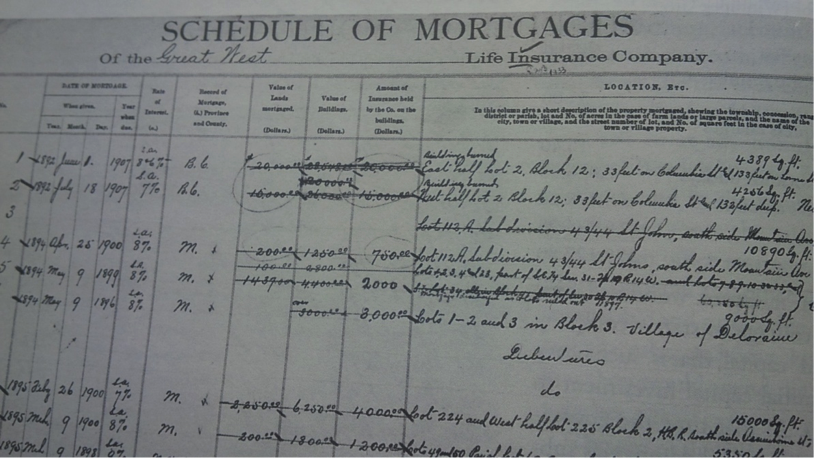
How we tracked mortgages, once upon a time.
While our sense of purpose has evolved with the growth of our company, it hasn’t fundamentally changed. In the late 1800s, access to financial products to aid the new and growing western-based economy was difficult and for the most part, was sourced by companies based out of eastern Canada. In 1891, our company was formed with a clear objective – to provide farmers in western Canada mortgages at fair interest rates. Providing mortgages and financial support tools was the foundation of our business for many years.

Sometime between 1910 and 1920, a young, western Canadian farmer, Saskatchewan to be precise, found himself wanting to expand the family farm to meet the needs of his growing family. And, so it was, a mortgage was taken out with Great-West Life. Very appropriate since his needs were the very reason Great-West’s products were built.

That young farmer, as this story (perhaps predictably) goes, was my great-grandfather, James. I’m pretty sure James would be rather pleased that his great-grandson is now working for the company that saw and filled a need, and that our fundamental values haven’t changed.

Great-West was formed to help farmers in Western Canada.
Jumping forward about 100 years, we’re investing a lot of effort into health care. We’re researching and ensuring we manufacture products with clear purpose. Health care itself is highly inflationary, so I know we need to come up with product designs to help reduce costs. But, it’s health care, not cost care, so, with those same fundamentals, we’re filling a need by ensuring we pay the utmost attention to health needs. In short, we work to balance the health care needs of plan members with the affordability needs of plan sponsors. 

This approach means a few things to our products:
  • We take a long term view. As a multi-product carrier, it’s something we need to do. We know that certain drugs help patients avoid a disability, for example. So balancing today’s costs with longer term health benefits makes financial sense, and it makes sense for the well being of our plan members.
  • We go beyond paying a claim. If someone were at risk of drowning, you would throw him a life line? For sure, and you’d stick around until you were satisfied he was safe. If we see that plan members aren’t compliant with their health treatment, we increasingly challenge ourselves to identify those situations and offer support. Paying a claim is a necessary part of what we do, but it’s not always sufficient in helping plan members achieve better health.
  • We do our best to avoid hard rules. We’re all different; we have different DNA, different habits and different capabilities when it comes to managing health. It’s easier to implement rigid rules than to recognize these differences. But, where we can, we try to offer exception processes and case management processes. In exchange, we ask plan members to try lowest cost services where they can. 
We seek to offer products that leave no Canadian behind
When we accomplish these things, I believe we’re succeeding in manufacturing our products responsibly, earning our administration fees and meeting our purpose. In short, we seek to offer products that leave no Canadian behind.

Will our products sell better or be more profitable with this approach? To be honest, I’m not sure, but I do know that no matter what our approach, not every customer will choose our products. I hope that those who do choose our products, will be aligned with our sense of purpose and fundamental values.


Tuesday, 11 June 2013

GroupNet Text is here!

Canadians send 274 million text messages every day.
When something’s this popular, you have to be part of it!

Great-West’s just-released GroupNet Text gives plan members access to their benefits plan details through text messaging.


GroupNet™ Text  provides plan information on mobile devices including:
  • Plan number and member ID
  • Coverage details*
  • Co-insurance amount
  • Benefit maximums, balances and more.

To sign up for GroupNet Text, plan members can log on to Great-West’s GroupNet for Plan Members and update their selection in the Your Profile tab. Click here to visit GroupNet now!

*Plan details available depend on plan design. Compatibility of GroupNet Text may vary by mobile device and/or operating system. Charges may be incurred depending on the user’s cell phone contract.


Friday, 17 May 2013

Drug Co-pay Cards & Coupons


Drug co-pay cards and coupons and their impact on benefit plan costs
We’re used to using coupons for anything from free movie admission to cereal. What’s not to like? They’re easy to use and you save some money. But since when have coupons for prescription drugs been popular? The fact of the matter is they’re quite common but drug coupons don’t work quite the same way as a other coupons.

Using drug coupons 
Typically, patients get drug co-pay cards or coupons, from their physicians but they’re also available from other sources including pharmacists and the drug manufacturer’s website.

Co-pay cards or coupons for the most part, are available for brand name drugs only. When the pharmacist bills for the medication, he/she uses the card like a pay-direct drug card to electronically direct part of the patient’s cost (coinsurance, deductible or co-pay) to the manufacturer of the drug. Sounds good so far, right?

The thing is, co-pay cards or coupons might actually cost the benefits plan:
  • In an environment where generic equivalents can cost as little as 18% of the price of their brand name equivalent, a $30 coupon doesn’t go very far when the cost of the brand name drug is $100.
  • Some co-pay cards and coupons are designed to be the payer of last resort. That means the drug manufacturer is the last payer after the drug plan has paid.

For example:
Jim’s doctor writes a prescription for Crestor with ‘no substitution’ indicated on it along with a $30 Crestor co-pay coupon to help pay for the cost of the medication.
Jim’s coinsurance is 20% and includes regular generic substitution.

Scenario 1:
Jim has coverage through his own group plan as well as his spouse's
Crestor cost $100
Plan cost $80
Spouse's plan $20
Amount paid by coupon $0

Scenario 2:
Jim has coverage under his plan only
Crestor cost $100
Plan cost $80
Amount paid by coupon $20

We have a fix!

Many drugs are available in both generic and brand name forms. Generic forms are typically less expensive but are just as effective as brand name forms. They’ve been approved by Health Canada as equivalent and have the same active chemical ingredient, same dosage strength and same dosage form.

A fail safe solution to avoid unnecessary drug claim costs is implementing Great-West’s Enhanced Generic Substitution into your plan. This plan design element ensures that reimbursement is limited to the cost of the generic version of the drug (even in situations where the prescribing physician has indicated ‘no substitution’ on the prescription). 

Here’s what happens when Great-West’s Enhanced Generic Substitution is implemented into a plan. 

Scenario 3:
Jim's plan includes Enhanced Generic Substitution (EGS)
Crestor cost $100
Plan cost $23 (cost of the generic version)
Amount paid by coupon $30

Wednesday, 1 May 2013

Shopping With Someone Else’s Money


Generally speaking, when you purchase a product, you research, compare, make the decision, and finally, pay for it. Of course, a big part of the process is shopping for the best price. 

Compare this to the process of getting a prescription drug. It’s kind of like shopping with someone else’s money.

Role                             Played by
The consumer              The patient
The decision maker      The doctor
The payer                     The employer’s group benefits plan

Essentially, the consumer is prescribed a drug by the decision maker. The consumer gets the prescription but all or most of the cost is absorbed by the employer’s group benefits plan. Consumers don’t have to shop for the best price – they might not even know that prices on prescription drugs vary, or they might feel that cost doesn’t matter because they’re only responsible for paying a small portion of the cost. As a result, the payer, (the employer) pays, but hasn’t had any say.  

Sometimes when doctors ask “do you have a drug plan?” it’s their way of asking “do you care how much this costs?” Let’s be fair. Doctors aren’t trained in the world of group insurance, or the impact of claims experience on premiums - this doesn’t fall under the umbrella of their responsibilities. But we’re working to make an impact where we can. When asked, one of our goals is to change the way patients answer this question. 

From the sponsor’s perspective, it’s complex. They want to provide a plan that’s both comprehensive and sustainable, but they’re struggling with the affordability. Plan sponsors fund drug plans, but have had little control over the actual payment process - until now. 

We’re prepared

We’ve developed DrugSolutions, a series of drug plan management options and solutions that focus on balancing the cost to the plan sponsor with the health care needs of their employees. Options and solutions include:

Enhanced Generic Substitution – Generic versions of brand name drugs can cost as little as 18 per cent of the brand name. With Enhanced Generic substitution implemented into a plan design, reimbursement of a drug claim is limited to the cost of the generic equivalent. 

Health Case Management – Taking specialty medications can be overwhelming. Unfamiliar terms, instructions and side effects, can be stressful. This program provides support to enhance the patient’s experience and help him or her understand and adhere to the treatment plan. 

Balance

We’re listening carefully to the concerns of plan sponsors and including their voice in the drug purchasing conversation. Implementing new plan design options can bring balance to contributing to better health outcomes and quality of life, while reducing the cost assumed by plan sponsors.

Barb Martinez, 
Practice Leader, Benefits Solutions


Thursday, 14 February 2013

Brand Name Drugs vs Generic - Part II

What generic drugs mean to business (not just a benefits plan)
The recent National Post article on generic drugs is a topical reminder on the issue of generics, brand names and cost management.   
Generic vs Brand Name drugs

Who says generics and brand name drugs are the same?
Luckily, there’s an independent body that validates whether a generic and a brand name drug are the same - Health Canada. See Health Canada regulates the effectiveness of generic medications. Their regulations are complex and rigorous but ultimately, tests are in place to ensure the generic version of a drug works the same as the brand name for the vast majority of people. 

Friday, 18 January 2013

The Need for Industry Pooling on High Cost Drug Claims


The high cost drug landscape
Over the past decade, on average, prescription drug plan costs have increased between 9-12% each year. These increases have largely been driven by blockbuster drugs such as Lipitor and Crestor.  However, the face of the prescription drug landscape is changing.  Recently, cost increases have slowed due to drugs coming off patent and legislative changes to generic drug prices. Meanwhile the cost and claiming frequency of high cost biologic drugs continues to increase.  


In fact, according to our 2010 data, the total annual cost associated with specialty medications was 97% of the total annual cost of acute medications (such as antibiotics). Based on our figures, the average annual cost per claimant for specialty medications claims is over 136 times higher!

Medical advances have led to a significant increase in the number of high cost prescription drug therapies.  Although their annual costs can be considerable (sometimes well over $50,000 per year), these medications are often life-changing. 

Forecasted growth in the number of high cost drugs available and prescribed in the Canadian market is causing concern among plan sponsors and insurers. This scenario could result in strain for both the plan sponsor trying to control the rising cost of a renewal, and the plan member who may be facing a reduction in coverage of his or her drug therapy.  Given the life-changing nature of these blockbuster drugs, we believe the best approach to managing these costs is the combination of a strong prior authorization process and a mechanism to spread the potential costs across the industry.

The industry solution
Canadian life and health insurers have come together to offer a new drug pooling framework, designed to help protect private benefits plans from the impact of high cost drugs.

Monday, 12 November 2012

Diabetes Awareness in November


All of us know a few people who have diabetes. We hear about insulin, Type 1 and Type 2 but do you know the basics?


Facts you should know

Type 1 Diabetes occurs when the pancreas which produces insulin, doesn’t work. It produces little or no insulin.
  • About 10% of diabetics have Type 1.
  • Type 1 can’t be prevented.
Type 2 Diabetes occurs when the body does not produce enough insulin or the insulin being produced doesn’t work well.
  • About 90% of diabetics have Type 2.
  • In some cases, Type 2 is preventable.

Gestational diabetes
occurs in pregnant women. This type of diabetes is temporary.
About 3.7% of pregnant women develop gestational diabetes. This percentage is higher with aboriginal women. Women who develop gestational are at a higher risk of developing Type 2 diabetes later in their lives.

What exactly, is insulin?
Insulin is a hormone that helps your body control its glucose or blood sugar level. Your body gets energy by making glucose from foods like bread, pasta, milk and fruit. Insulin helps keep the body’s blood glucose at a healthy level.

According to the Canadian Diabetes Association, more than 9 million Canadians live with diabetes or prediabetes.


Saturday, 6 October 2012

More Ways to be Mobile


You're on the go - so are we!

GroupNet Mobile - available for your Android device, BlackBerry and iPhone. Same great app, three different ways to connect!

GroupNet™ Mobile, Great-West Life’s free mobile app, lets you use your Android device, BlackBerry or iPhone to:

  • Submit claims online with Member eClaims – part of our industry-leading GroupNet online services
  • Access personalized coverage information about your benefits, claims and more – quickly and easily, any time
  • View card information including: member ID, Drug, and Global Medical Assistance
  • Locate the nearest provider who has access to Provider eClaims through a built-in GPS mapping tool.

Click to visit the iTunes App Store - GroupNet Mobile for iPhone
Click to visit the Google Play Store - GroupNet Mobile for Android
Click to visit the BlackBerry App World - GroupNet Mobile for BlackBerry

For more info, please visit the GroupNet section of the Great-West Life website. 

GroupNet Mobile for iPhone


Tuesday, 14 August 2012

The GroupNet Mobile App


GroupNet Mobile
Great-West’s GroupNet™ Mobile app
Convenient technology and access to benefits information.

GroupNet Mobile, our newest free app lets plan members use their iPhone or iPod touch to:
  • Submit claims online.
  • Access personalized coverage information about benefits, claims and more.
  • View card information including: Member ID, Drug, and Global Medical Assistance.
  • Locate the neared provider who has access to Provider eClaims through a built-in GPS mapping tool.

The GroupNet Mobile app is available free from the App Store at www.itunes.ca/appstore. More to come - GroupNet Mobile for BlackBerry and Android will be released this fall.


GroupNet Screenshots

Thursday, 26 July 2012

The Benefit of Great-West Life

Great-West Life is a leading provider of group benefits and group retirement services for Canadians.

Group Benefits

A group benefits plan can help you attract and retain valuable employees or members.

Our flexible and innovative benefits plans - featuring benefits like healthcare, dentalcare and disability, plus convenient online services - can be tailored to fit the specific needs of your organization, whether it's large or small.

Stay tuned to our Facebook, Twitter and Blog for updates, information and advice on group benefits and savings.

- The Great-West Life Group Benefits Team

Friday, 20 July 2012

Why We’re Here


We’re passionate about what we do. We work hard to develop products and strategies that meet our clients’ needs, about studying and analyzing trends, and of course, about communicating.

Visit our blog for insights into what we’re seeing in industry trends, changing prescription drug legislation and other issues that impact your business.